
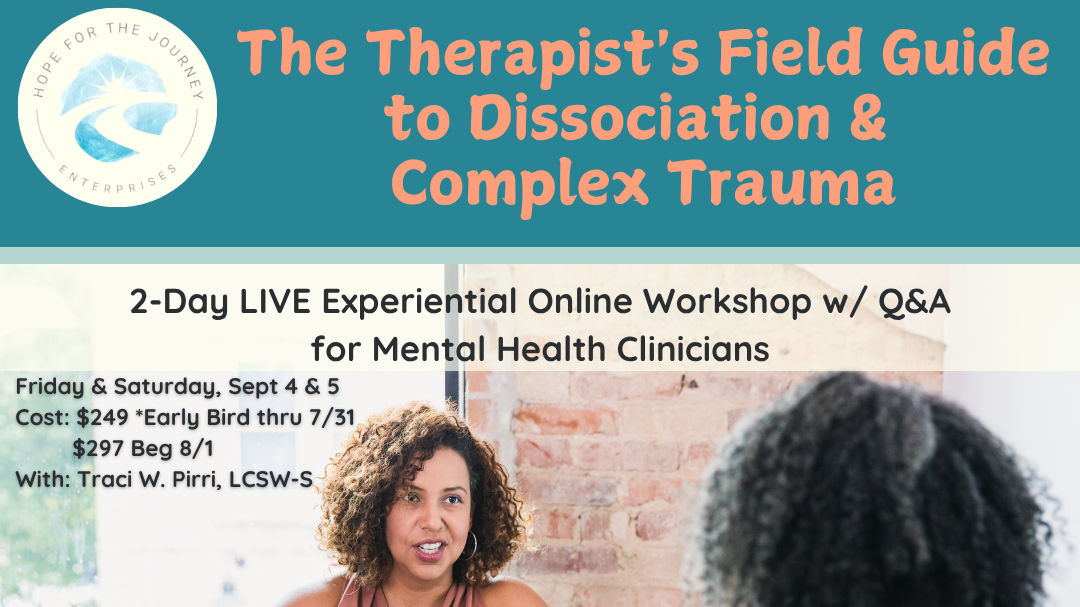
The Therapist's Field Guide to Dissociation
& Complex Trauma
Stop feeling unsure. Start feeling confident. Start helping more people...safely.
Even if you've been trained in awesome trauma modalities like EMDR, IFS, or Somatic Experiencing, you need to understand the basics of complex trauma and dissociation to work safely with this population.
This course was created to bridge the gap so you can help more people, especially those who have been told they can't be helped in the past.
What you'll get:
- How to assess for dissociation with confidence
- Experiential learning & hands-on application
- Practical tools you can use with clients immediately
- 12 CEU’s approved by NASW – for social workers across the U.S.
- CEU’s also available for all Texas licensures
Outside of TX? Check with your licensing board for reciprocity.
With Traci W. Pirri, LCSW-S
September 4th and 5th, 2026
Early Enrollment Price: $249
We offer a 20% discount for BIPOC therapists. Use code: BIPOC at checkout.
ENROLL NOW

Keep Your Treatment
Plan on Point
Assessment
Did you know that people with Dissociative Identity Disorder typically spend 3-5 years in treatment before getting an accurate diagnosis? Learning how to effectively assess for dissociation from the start will keep your treatment plan on point, saving your clients time, money, and heartbreak.
Case Conceptualization
Holding a sturdy frame for therapy provides structure, support and safety for clients with complex trauma. This training will give you the skills to understand what to do and when.
Knowing When To Progress
The biggest mistake clinicians make with clients with complex trauma is to move too quickly into memory work. That, or they get so scared of it, they never move beyond supportive therapy. This training will help you feel confident in knowing when to slow down and when to move forward.
I'm a Yes!Understand the Basics of Complex Trauma and Dissociation
What You'll Learn
- How to assess
- How to make the treatment safe
- Case Conceptualization
- How to effectively use EMDR, IFS, and more with complex trauma
How You'll Learn
- Experiential
- Loads of examples
- Live Q&A
- Videos
What to Expect
- Lots of participation
- Resources to use with clients
- Increase in your confidence levels
- Minimal therapy jargon
- Access to OnDemand video recording for 6 months (for review or those who can’t make it live)
Plus 12 CEU’s approved by NASW – for social workers across the U.S.

Free Download: Dissociation Cheat Sheet for Therapists
Learn how to identify dissociative symptoms in your clients with clarity and confidence.
This 1-page clinical guide includes:
✔️ What to look for
✔️ How to respond gently
✔️ Pacing & language tips for real sessions
Perfect for trauma therapists, EMDR clinicians, and anyone supporting highly dissociative clients.
Sign up below to receive your free digital download.
By signing up, you’ll also receive occasional updates, tools, and trainings from Hope For The Journey. Unsubscribe anytime.

Meet Your Facilitator
Traci W. Pirri, LCSW-S founded Hope For The Journey Collective, a non-profit group practice with two locations in the Austin, Texas area. She is an EMDRIA-Approved Consultant and was one of the first trained in Trauma-Focused Cognitive Behavioral Therapy in the country. Her clinical focus areas are sexual trauma, complex and attachment trauma (including adoption), dissociative disorders, and EMDR. Traci is passionate about helping other clinicians to feel confident working with complex trauma and dissociation while minimizing the risk of burnout. She is an entrepreneur, speaker, and educator on topics related to dissociation, EMDR, complex trauma, and sexual trauma
MEET TRACIWhat People Are Saying
- 4.8 ⭐⭐⭐⭐⭐
- 100% of participants would recommend this course
- “Great training!”
- “Traci presented the information in a digestible way. I feel a lot more confident about my ability to assess for and address dissociation in the therapeutic space.”